

In original English, the term lease means renting out. Sudzuka (2014) argues that in contemporary business and legal terminology, the term leasing obtains a derived juridical meaning. The simplest nature of lease, however, can be summed up in two aspects: delivery and leasing. The former speaks to the rights and obligations of the landlord, whereas the latter is directed to the rights and obligations of the tenant. These two parties are then bound by a contract which is now referred to as a lease agreement. Where the one leasing is referred to as the lessor, the one occupying the premises is referred to as the lessee.
In South Africa, every contract has five compulsory pre-requisites. Without any of these five elements, the contract cannot be legally binding (Van Huyssteen & Maxwell, 2021). Those core requirements are consensus, legal capacity, physical ability, formality, and legality.
The lease agreement contract has its own pre-requisite core requirements — the three Ps:
- Price: the rental amount
- Parties: the lessee and lessor
- Property: where the occupation will take place
In addition to these binding clauses, the landlord will then add other clauses. The aim of this blog is to highlight some of the clauses that must be included in the lease — which most landlords do not include or practice — and some that tenants might overlook, even though it is their right to exercise them.
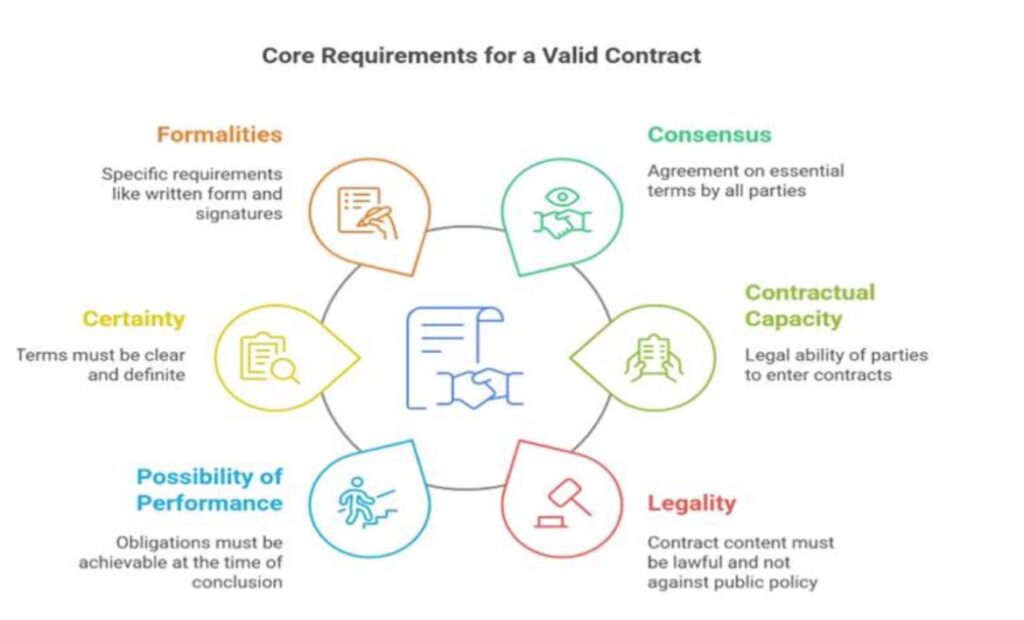
Here is the list below:
- For every lease, a clause must be inserted that requires the landlord to provide a receipt for all income that they receive. This is a right that most tenants do not exercise.
- Deposits must be invested by the landlord in an interest-bearing account with a financial institution, provided that the rate applicable to such an account may not be less than the rate applicable to a savings account with that financial institution, with proof of interest.
- The balance of the deposit and any interest, if applicable, must be refunded by the landlord to the tenant no later than 14 days after the dwelling is restored to the landlord.
- At the expiration of the lease, the landlord must arrange a joint inspection of the dwelling at a mutually convenient time, to take place within a period of three days prior to such expiration.
References
Sudzuka, E. (2014). Legal nature of a lease agreement. Law Theory & Prac., 31, 1.
Van Huyssteen, L. F., & Maxwell, C. J. (2021). Contract Law in South Africa. Kluwer Law International BV.